
What is Revenue Orchestration?
Revenue orchestration goes beyond campaign scheduling or lead hand-offs. It’s about real-time coordination of actions across the entire customer lifecycle—driven by intent signals, behavior patterns, and revenue impact metrics.
Think of it like moving from a one-channel playlist to a real-time, multi-instrument revenue symphony.
Why Automation Alone Falls Short
Here’s the reality:
- Marketing Automation platforms (MAPs) help drive top-of-funnel engagement.
- Sales Engagement tools help with outbound touches.
- CS platforms help with renewals and expansions.
But none of them orchestrate full-funnel, multi-touch revenue motions in real time.
The result?
- Disjointed customer experiences.
- Dropped hand-offs.
- Misaligned targeting across teams.
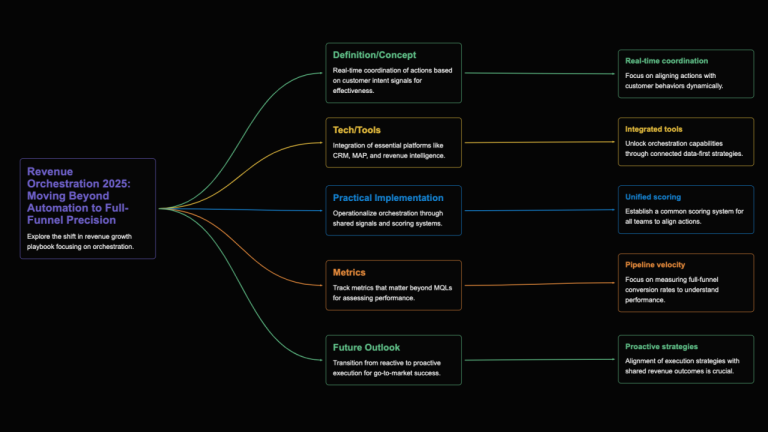
By Shivani Seth | RevOps & GTM Strategy
Revenue Orchestration 2025: Beyond Marketing Automation to Full-Funnel Precision
In 2025, the playbook for revenue growth has fundamentally shifted.
Traditional marketing automation—email nurtures, lead scoring, basic drip campaigns—was never designed to orchestrate real-time, cross-functional revenue motions.
Today’s go-to-market leaders are asking a different question: 👉 How do we create connected, signal-driven journeys across Marketing, Sales, Customer Success, and even Product teams?
Welcome to the era of Revenue Orchestration.
What Revenue Orchestration Looks Like in Practice
Here’s how leading organizations are operationalizing Revenue Orchestration today:
1. Signal-Based Triggers Across Teams
- Product usage drop? Trigger a CSM outreach.
- Intent surge at target accounts? Launch Sales outbound + ABM retargeting.
- Stage stagnation in pipeline? Auto-activate nurture or exec outreach
2. Unified Lead and Account Scoring Models
- No more marketing vs sales scoring conflicts.
- One unified scoring system feeding all GTM motions: inbound, outbound, expansion.
3. Cross-Channel Cadence Automation
- Orchestrating actions across email, ads, sales outreach, product in-app messaging, and customer success touchpoints.
4. Real-Time Revenue Intelligence Feedback Loops
- Insights from pipeline progression, engagement drop-offs, and conversion rates constantly inform next-best-actions.
Where is your organization today on the Revenue Orchestration maturity curve? Are your marketing, sales, and customer teams still operating in silos—or are you already orchestrating cross-functional revenue motions?
Shivani Seth
The Tech Layer: What Enables Revenue Orchestration?
Revenue orchestration doesn’t mean buying yet another tool—but it does require a data-first approach and orchestration-ready infrastructure.
- Connected CRM + MAP + Sales Engagement + Product Usage Data
- Real-Time Signal Detection (via CDPs, intent platforms, etc.)
- Revenue Intelligence Platforms
- Orchestration Tools (like Demandbase, 6sense, or custom RevOps automation layers)
Metrics that Matter for Revenue Orchestration
Stop measuring just MQLs or email CTRs.
Here’s what leading RevOps teams are tracking instead:
- Pipeline Velocity
- Account Engagement Heat Scores
- Full-Funnel Conversion Rates (by segment, channel, and persona)
- Expansion & Retention Triggers
- Revenue per Orchestrated Motion
Looking Ahead: From Reactive to Proactive GTM Execution
Revenue orchestration isn’t a MarTech buzzword—it’s a fundamental shift in how go-to-market teams operate.
Success in 2025 depends on:
- Acting on buyer signals in the moment
- Coordinating cross-functional plays automatically
- Aligning your GTM teams around shared revenue outcomes
What’s Next for You?
Where is your organization today on the Revenue Orchestration maturity curve? Are your marketing, sales, and customer teams still operating in silos—or are you already orchestrating cross-functional revenue motions?
Would love to hear how you’re tackling this in your GTM strategy. Let’s connect and share notes.